
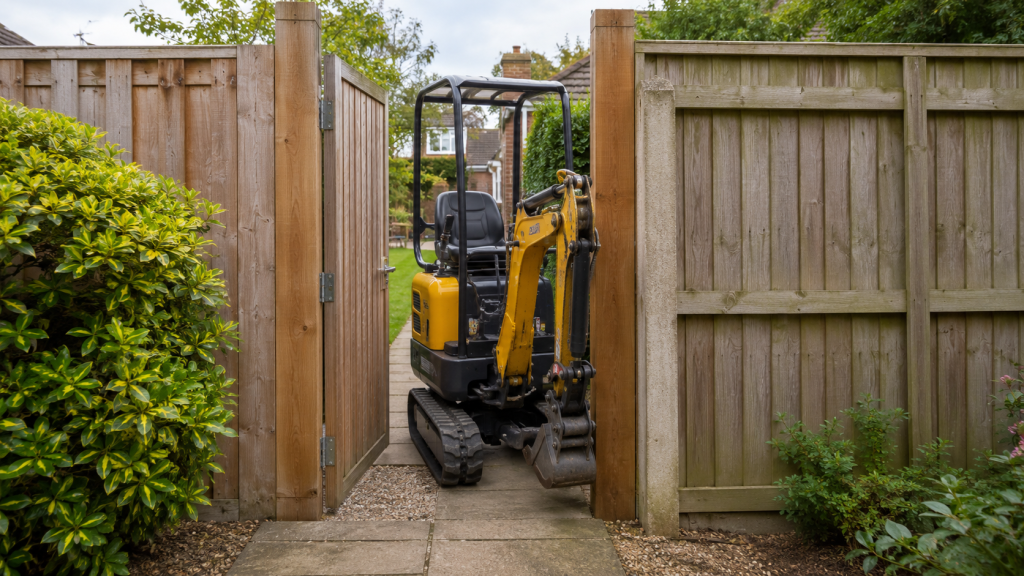
If you’re planning a garden renovation, extension, new patio, drainage work or landscaping project, hiring a digger could save a huge amount of time and back-breaking manual labour.
But there’s one question many homeowners forget to ask until the project is about to begin:
Will the digger actually fit into the garden?
For properties across Essex, particularly terraced and semi-detached homes with narrow side access, getting machinery to the working area can be just as important as choosing the right machine for the job.
Fortunately, modern micro diggers are specifically designed for restricted access.
How Wide Does Access Need to Be for a Mini Digger?
There isn’t a single answer because mini diggers come in different sizes.
Sach Plant Hire’s smallest Kubota K008-3 micro digger is listed with a minimum width of just 700mm, making it particularly useful for garden gates, alleyways and other restricted access situations. Despite its compact dimensions, it has a maximum digging depth of approximately 2.4 metres. Sach Plant Hire digger range
Larger machines naturally require more room. For example, Sach Plant Hire’s Kubota KX018-4 and KX019-4 mini diggers have a minimum width of 1,000mm, while larger midi diggers require substantially more space.
This is why measuring your access before booking plant hire is so important.
What Should You Measure?
Don’t simply measure your garden gate and assume everything will be fine.
You need to consider the entire route from the delivery point to the area where the digger will actually be working.
Measure:
- The narrowest point of your garden gate
- Side passages and alleyways
- Gaps between walls, fences and buildings
- Doorways or other restricted openings
- Sharp corners and changes of direction
- Overhanging branches
- Low structures or obstructions
- Steps and significant changes in ground level
Remember that a machine needs sufficient room to manoeuvre, not merely squeeze through the narrowest opening.
What If I Only Have a Narrow Side Entrance?
This is exactly the type of situation where a micro digger can come into its own.
A compact machine can provide mechanical digging power in places that would previously have required excavation by hand.
This can be useful for jobs including:
- Garden landscaping
- Patio preparation
- Pond excavation
- Drainage work
- Trenches
- Foundations
- Garden room bases
- Extensions
- Removing soil
- Preparing areas for driveways and paths
For a homeowner, the difference can be considerable. Moving several tonnes of earth manually with a shovel and wheelbarrow is very different from having the right piece of machinery on site.
Don’t Forget About the Dumper
There’s another practical consideration that is easily overlooked.
Getting the digger into the garden is only half the problem.
How are you going to get all the excavated soil out?
A surprisingly large amount of spoil can be produced when digging foundations, lowering a garden, installing drainage or preparing a patio.
Before work begins, think about the complete route for moving material from the excavation to your skip, grab lorry or collection point.
Depending on the site, pairing the right digger with suitable material-handling equipment can make the whole job substantially quicker.
Bigger Isn’t Always Better
It’s tempting to hire the biggest machine that will physically fit, particularly if you have a substantial amount of digging to do.
However, the best digger is the one suited to both the job and the site.
A larger excavator can offer greater digging depth, reach and capacity, but it also needs more room to operate. In a residential garden, a smaller machine may be considerably more practical.
Sach Plant Hire offers machines ranging from compact micro diggers through to much larger excavators, so choosing the right size should be based on what needs excavating, the available access and the working space once the machine is in position. See the available diggers
Check What’s Under the Ground
Access isn’t the only thing you need to consider before digging.
You also need to establish whether there are underground services in or near the area you intend to excavate.
These could include electricity cables, gas pipes, water supplies, drainage and communications cables.
Never assume that because you’re working in a back garden there won’t be anything underneath you.
Self-Hire or Digger and Driver?
If you’re experienced and comfortable operating plant machinery, self-hire may be suitable.
If you’re not, hiring a digger with an experienced operator can often be the better option, particularly where access is tight or you’re working close to buildings, fences or existing landscaping.
An experienced operator can also make an enormous difference to how efficiently the excavation itself is completed.
Not Sure What Will Fit? Ask Before You Hire
If you’re uncertain whether a digger can reach your garden, don’t guess.
Measure the access, take photographs of any particularly narrow areas and discuss the project before booking.
At Sach Plant Hire, we have 50 years’ experience in groundworks, demolition and plant machinery, with equipment available for both self-hire and operator hire across Essex. About Sach Plant Hire
We can help you choose a machine suited to the work you need to undertake and, crucially, the space available to get it there.
For advice on micro and mini digger hire in Essex, contact Sach Plant Hire on 07801 924 918 or 0345 337 3396.