
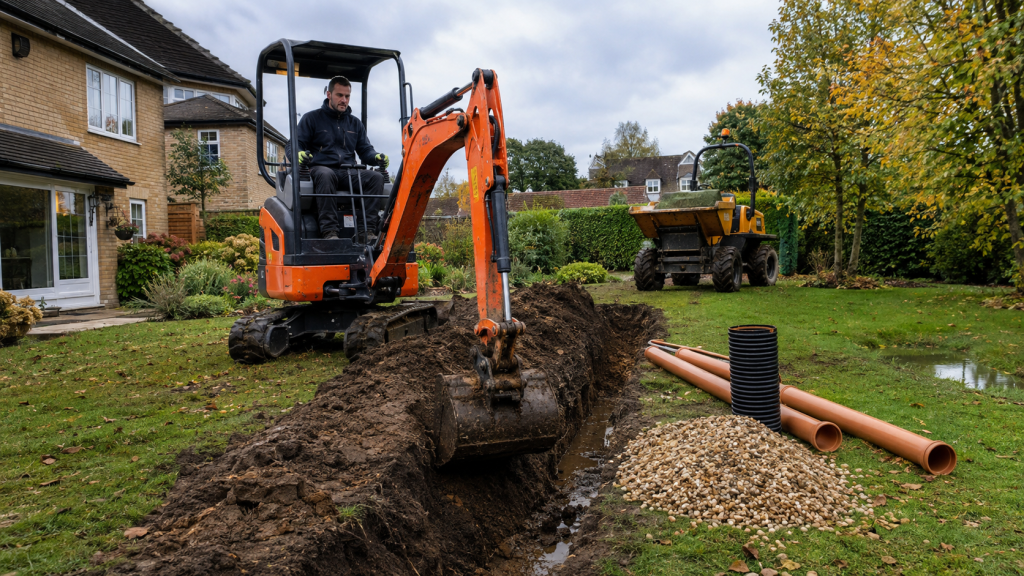
Early autumn can reveal a lot about how well a garden, driveway or building plot handles water. After the drier months, heavier and more frequent rainfall can quickly expose areas where water collects, drains slowly or flows towards buildings.
September is therefore a good time to tackle drainage and groundwork projects before the wetter conditions of late autumn and winter arrive. With the right preparation and machinery, many problems can be addressed before saturated ground makes excavation more difficult and disruptive.
Signs That Your Property May Have a Drainage Problem
Drainage problems are not always obvious during dry weather. Once regular rainfall returns, you may notice:
- Puddles remaining on lawns, patios or driveways
- Soft, boggy or waterlogged areas in the garden
- Water flowing towards the house, garage or outbuilding
- Soil washing away from sloping areas
- Damp patches appearing around external walls
- Overflowing or slow-moving garden drains
- Driveway surfaces beginning to sink or become uneven
These warning signs should not be ignored. Persistent standing water can damage lawns, planting, paving and driveway foundations. Water collecting close to a building may also contribute to damp and other maintenance problems.
Why Deal with Drainage in Early Autumn?
Waiting until the middle of winter can make drainage work more complicated. Prolonged rain may leave the ground saturated, increasing the amount of mud and making it harder to move machinery, soil and materials around the site.
Carrying out the work earlier offers several advantages.
Problems Are Easier to Identify
The first periods of sustained autumn rain can show exactly where water is collecting and which way it moves across the property. This makes it easier to determine which areas need attention.
Ground Conditions May Be More Manageable
Although the soil may be moist, it is often more workable in early autumn than during the wettest part of winter. This can make excavation, levelling and reinstatement more straightforward.
Your Property Is Better Prepared for Winter
Completing drainage improvements before prolonged winter rainfall can help protect lawns, paths, driveways, foundations and outdoor buildings during the months when they are most likely to be affected.
Landscaping Can Recover More Quickly
Where lawns or planted areas need to be disturbed, completing the project during early autumn may give the garden time to settle and recover before the coldest weather arrives.
Common Autumn Drainage and Groundwork Projects
The correct solution depends on the layout of the site, the soil conditions and the cause of the problem. Common projects include the following.
Digging Drainage Trenches
Trenches may be required for drainage pipes, channels or other systems designed to carry water away from problem areas. A mini digger can create a more consistent trench much faster than digging entirely by hand.
Before excavation begins, the route must be checked carefully for underground pipes, cables and other services.
Installing Soakaways
A soakaway is designed to collect surface water and allow it to disperse gradually into suitable surrounding ground. Installing one normally involves excavation, drainage materials and connecting pipework.
The location and design must be appropriate for the property and local ground conditions. A professional assessment may be needed before work starts.
Preparing Ground for French Drains
French drains can help redirect water from persistently wet areas. They generally involve a trench containing a perforated pipe surrounded by suitable drainage stone.
Accuracy is important because the trench must follow the intended route and gradient. The excavated soil will also need to be removed or redistributed safely.
Improving Driveway Drainage
Poor drainage can weaken a driveway base, encourage surface deterioration and create puddles near entrances or garages. Work may involve installing channels, correcting levels or excavating and rebuilding affected sections.
Proper compaction is equally important. A well-prepared and compacted base helps create a stable surface capable of coping with vehicles and seasonal weather.
Levelling and Reshaping Gardens
Water may collect because the garden slopes towards the house or contains low points. Carefully adjusting ground levels can encourage surface water to move in a safer direction.
This work requires planning. Simply moving soil from one area to another without considering the wider flow of water can transfer the problem elsewhere.
How a Mini Digger Can Help
Drainage projects often involve moving considerably more soil than expected. Even a relatively narrow trench can produce a substantial amount of spoil once it extends across a garden or driveway.
A mini or micro digger can help with:
- Excavating trenches
- Removing old surfaces
- Digging soakaway areas
- Reshaping sloping ground
- Loading excavated soil
- Preparing new driveway bases
- Clearing damaged landscaping
- Creating accurate levels
Compact machinery is particularly useful in residential gardens where access and working space are limited. Where access is especially restricted, a micro digger may be able to pass through narrower gateways and side entrances.
A suitable dumper can also make it much easier to move excavated soil, stone and other materials between the working area and the collection point.
Do You Need a Digger and Driver?
Self-hire may suit experienced customers who are confident operating plant machinery and fully understand the site. However, drainage work frequently requires accurate excavation, careful level control and safe operation around existing structures and underground services.
Hiring a digger with an experienced operator can help the project progress more efficiently. It can be particularly valuable when:
- The working area is confined
- The garden has several different levels
- Excavation is close to a building
- Accurate trench depths or gradients are required
- Access is difficult
- A large volume of material needs to be moved
- You are unsure which machine is suitable
An experienced operator can also help reduce unnecessary disturbance by using machinery appropriate for the available access and ground conditions.
Plan the Complete Job Before Hiring Machinery
Before arranging plant hire, consider more than the excavation itself.
Ask where the digger will enter, whether gates or fencing need to be moved and how excavated soil will leave the property. You should also decide whether the spoil will be reused, loaded into a skip or removed from the site.
Check the available working space, overhead clearance and the condition of the access route. Underground services must be identified before any digging begins.
Planning these details in advance can prevent delays and ensure the chosen digger, dumper and compaction equipment are appropriate for the project.
Prepare Your Property Before the Wettest Weather Arrives
Early autumn provides a useful opportunity to identify drainage problems and complete essential groundwork before winter conditions make them worse.
Whether you need to excavate drainage trenches, install a soakaway, reshape a waterlogged garden or prepare a more stable driveway base, using the correct machinery can save considerable time and physical labour.
Sach Plant Hire supplies micro, mini and midi diggers, dumpers and compaction equipment for projects across Essex. Operated plant hire and professional groundwork services are also available for customers who would prefer the work to be handled by an experienced team.
Contact Sach Plant Hire to discuss your project, site access and the most suitable machinery for the job.